Checked at eight points,
not one.
Quality control at the end of a run only tells you how much you wasted. Ours runs from the fabric arriving to the box being sealed, so problems get found while they are still cheap to fix.
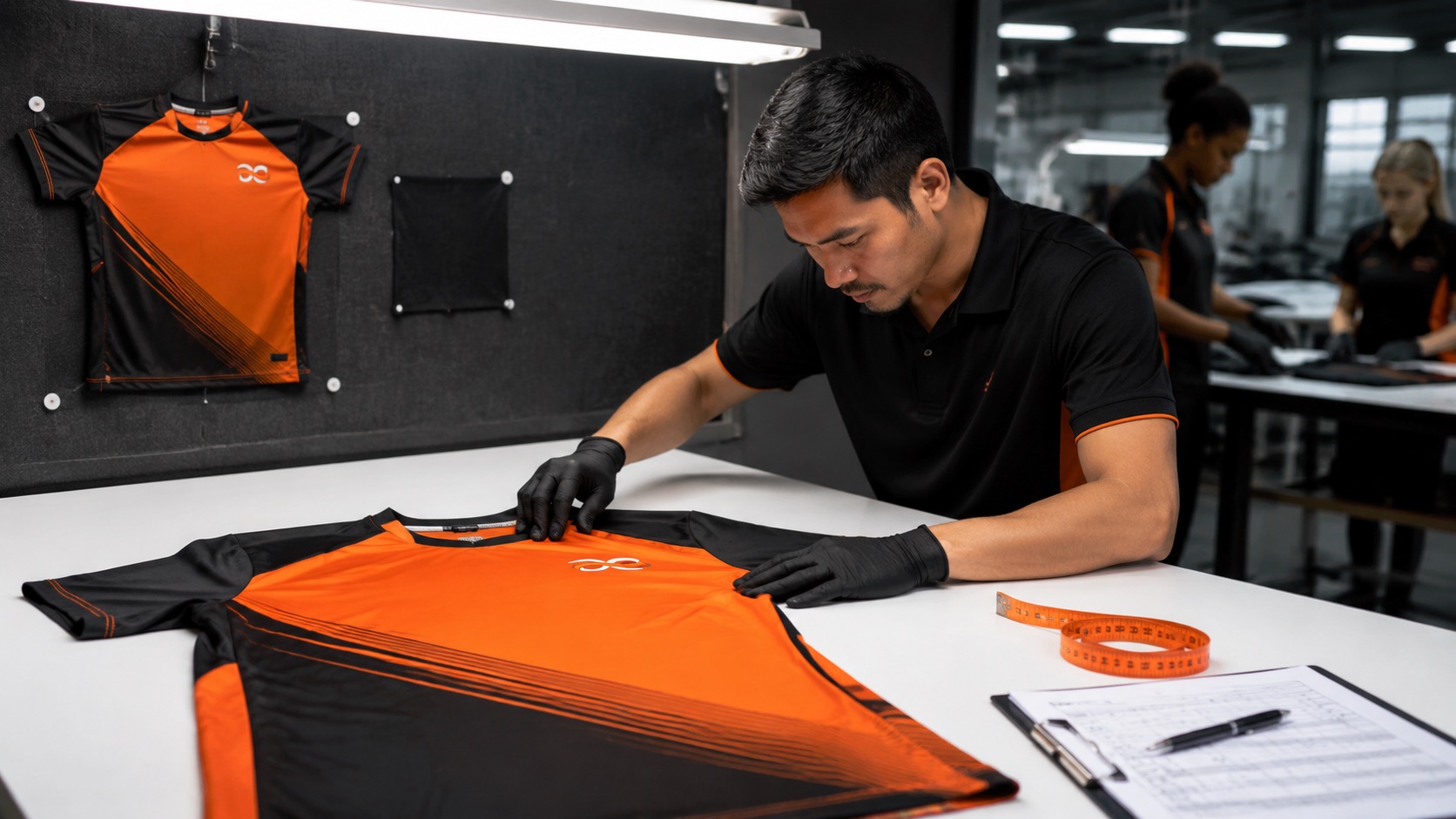
- 01
Incoming fabric
Every roll is checked for shade, weight and visible faults before it goes near a cutting table. A batch that is half a shade out is rejected at this point, because it cannot be fixed afterwards — it can only be re-cut.
- 02
Colour standard
Your colours are matched and recorded against a physical standard we keep on file. That is what makes a reorder six months later still sit next to last season's shirts without looking off.
- 03
Pattern and fit
The graded pattern is checked against measurements across the size run before bulk cutting. A block that fits at medium and fails at 3XL is a pattern problem, and it is cheapest to find here.
- 04
First-off inspection
The first garment off the line is checked in full against the approved sample — print placement, stitch density, seam type, label position. The line does not run on until it passes.
- 05
In-line checks
Inspection continues during the run rather than only at the end. Catching a decoration drift at piece 40 costs 40 pieces; catching it at piece 400 costs 400.
- 06
Decoration integrity
Embroidery is checked for pucker, tension and backing. Sublimation is checked for full penetration and edge bleed. DTF and DTG adhesion is checked by stretch and peel, not by eye alone.
- 07
Final inspection
Every garment is looked at before packing — measurements, decoration, trims, loose threads and finishing. Rejects are pulled and remade, not shipped and argued about later.
- 08
Packing check
Counted and packed to your specification, with the size breakdown verified against your order. A correct order packed wrong is still a wrong delivery.
Why in-house makes this possible
A factory that subcontracts its printing cannot inspect the printing while it happens — it can only inspect what comes back, days later, when remaking it costs the schedule. Because cutting, sewing, sublimation, embroidery, DTF and DTG all run under our own roof, a fault found at any stage goes back one step rather than out of the building.
It also means one person can answer for the whole garment. When something is wrong, you are not waiting while three suppliers decide whose fault it was.
Ask to see it before you commit.
We will walk you through the floor on a video call, or send inspection photos from a live run.